You hear it at every CEO roundtable, every board dinner, every frustrated text to a peer: “My leadership team won’t step up.”
The VP of Operations still escalates scheduling conflicts. The Director of Sales can’t hold her own team accountable for pipeline updates. The Head of Client Services calls you before making a decision that falls squarely in her lane. You promoted smart people. You gave them titles, teams, budgets. And still — everything flows back to you.
So you do what every responsible CEO does. You invest in manager training. And then you wait for things to change.
They don’t.
The Billion-Dollar Training Problem
Manager development is the number-one CHRO priority for two consecutive years, according to SHRM’s 2026 State of the Workplace report. U.S. companies spend an estimated $100 billion annually on leadership development. That number keeps climbing.
Yet Gallup consistently reports that only about one in three managers is engaged at work — and that manager engagement is declining faster than any other employee segment. The complaint hasn’t changed. CEOs still say the same thing they said five years ago: my managers aren’t managing.
Here’s what nobody in the training industry wants to say out loud: manager training assumes the problem is the manager. It assumes that if you teach people how to delegate, give feedback, or run a one-on-one, they’ll start doing those things. That assumption is wrong.
Not because managers are incapable. Because the operation wasn’t designed for them to manage.
Think about it this way. You can send someone to a driving school with the best instructors in the world. But if you hand them the keys to a car with no steering wheel, the training doesn’t matter. The vehicle isn’t built for what you’re asking them to do. That’s what’s happening inside most mid-market companies. Managers finish the workshop, walk back into the same undefined decision rights, the same unclear accountabilities, the same structural bottlenecks — and default to the only behavior the system rewards: firefighting.
Training doesn’t solve a design problem.
The Diagnostic: A RACI Walkthrough
If you want to find out whether your managers can manage, don’t send them to another workshop. Run a RACI.
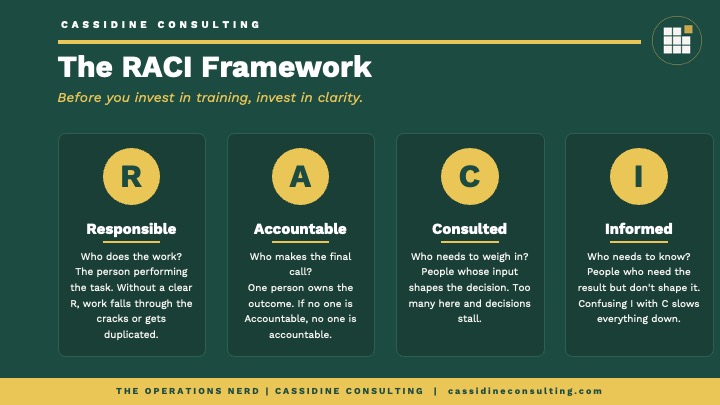
RACI stands for Responsible, Accountable, Consulted, and Informed. It’s a decision-rights framework that maps who does what across any process or function. It’s not new. It’s not flashy. But most companies have never done one — or did one years ago and filed it away.
Here’s what each letter means:
Responsible: The person who does the work. Hands on the task.
Accountable: The one person who owns the outcome. This is the single throat to choke — the person who answers for whether it got done right. There can only be one A per activity.
Consulted: People whose input is needed before a decision is made. This is a two-way conversation.
Informed: People who need to know what was decided, after the fact. One-way communication.
Simple enough. Now let’s make it real.
The Scenario: 120 Employees, Three Department Heads, Zero Clarity
Imagine a $30 million services company. 120 employees across three departments: Sales, Operations, and Client Services. The CEO — let’s call her Dana — keeps hearing the same complaint from clients: slow response times, missed follow-ups, inconsistent service quality.
Dana looks at her three department heads. The VP of Sales says retention is a Client Services problem. The Director of Client Services says Operations controls the delivery timeline and she can’t make promises she can’t keep. The VP of Operations says he’s never been told that client retention is part of his scope.
Everyone is pointing somewhere else. Not because they’re difficult. Because nobody assigned the A.
Dana runs a RACI on one process: client renewal and retention. She puts the key activities in a column:
1. Monitor client satisfaction scores
R: Client Services team (they collect NPS and feedback)
A: Director of Client Services (she owns the satisfaction number)
C: VP of Sales (for context on the original promise made)
I: VP of Operations (aware, not involved)
2. Identify at-risk accounts 90 days before renewal
R: Client Services team
A: Director of Client Services
C: VP of Sales, VP of Operations
I: CEO (flagged only if a top-ten client)
3. Develop and present a retention plan for at-risk accounts
R: Director of Client Services (builds the plan)
A: Director of Client Services
C: VP of Sales (pricing flexibility), VP of Operations (capacity)
I: CEO
4. Approve pricing or scope changes for retention
R: VP of Sales (proposes adjusted terms)
A: CEO (final sign-off on margin impact)
C: Director of Client Services, VP of Operations
I: Finance
Before this exercise, none of this was documented. The Director of Client Services didn’t know she owned retention. The VP of Sales assumed someone else was watching for churn signals. The VP of Operations had no idea he was supposed to be consulted on capacity before Client Services made retention promises.
The RACI made the invisible visible. In thirty minutes, Dana found three critical gaps in how her company is built — none of which had anything to do with her managers’ skill sets.
What the RACI Reveals: The Theory Reality Gap
Here’s where this gets interesting. When Dana says she wants “empowered managers who take ownership,” that’s her strategic intent. She means it. She invests in it. She talks about it in all-hands meetings.
But when you look at how the company is built — no documented decision rights, no single point of accountability for cross-functional outcomes, no clarity on who gets consulted versus who gets informed — you see a different picture. You see an operation designed to produce bottlenecked decisions, escalation loops, and firefighting.
That gap between what Dana says she wants and what the operation is built to deliver is the Cassidine Theory Reality Gap. It’s the distance between strategic intent and Operational Reality. Every company has one. Most CEOs feel it every day — they call it frustration.
When managers don’t manage, it’s not a people problem. It’s a design problem. The RACI is the diagnostic tool that measures the Theory Reality Gap at Level 2 — the part of the organization where strategy meets day-to-day operations. Where department heads either have the decision rights to lead, or where those rights were never assigned and the whole system defaults to the CEO.
Training teaches managers what to do. A RACI shows you whether the operation allows them to do it.
One costs money. The other creates clarity.
Where to Start
If you’re reading this and thinking, “this sounds like my company” — you’re not alone. Most mid-market CEOs are running organizations that have outgrown their original design. The managers you hired at 40 employees are now leading in a 150-person company with no structural update to match.
The RACI is a starting point. But it’s one piece of a larger diagnostic.
Want to see where your operation is set up for your managers to fail? Take the Theory Reality Gap Assessment. It takes ten minutes and shows you the specific gaps between your strategic intent and how your company is built to operate.
➤ cassidineconsulting.com/scorecard
Searcie Cassidine, MBA, LSSBB
Founder & Chief Operations Nerd, Cassidine Consulting | cassidineconsulting.com