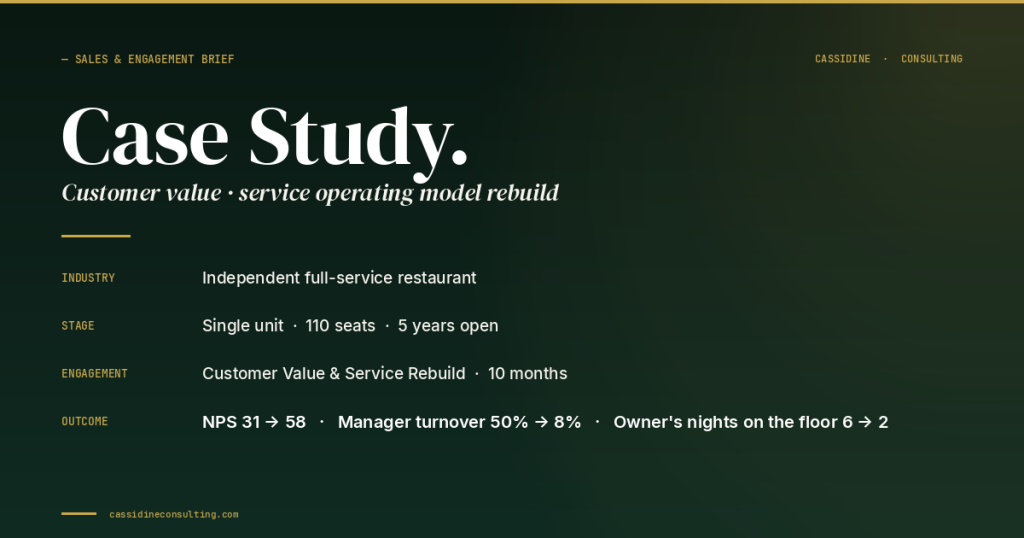
Representative engagement. Company, names, and figures are illustrative composites drawn from typical patterns across independent operators between $2M and $10M. Real client case studies available once written permissions are secured.
The setup
A chef-driven seasonal American concept in a major US metro. Opened in 2021. Built a reputation fast. Five years in, doing $5.4M in revenue, 110 seats, a strong following of neighborhood regulars and a steady flow of destination diners coming in from out of state.
The owner — a former corporate chef who left to build her own thing — was, by every objective measure, succeeding.
She also had not taken a Saturday off in eighteen months.
When she stepped onto the floor at 5:45 PM, she could feel whether the night was going to be good. The greeting was warm. The host knew who had a birthday. The bartender knew the regulars by drink. The pace was right. The room felt like the restaurant she had opened to deliver.
When she didn’t step onto the floor — Tuesday off, a sick day, a quick trip — something quietly drifted. The bartender ran out of garnish. A new server fired the wrong table. The host seated a four-top in the worst seat in the house.
She knew because the reviews told her. A five-star Wednesday. A two-star Saturday. Same menu. Same kitchen. Same playbook.
NPS had drifted from 62 at the eighteen-month mark to 31 by year five. Repeat-guest revenue had been declining for three straight quarters. Two managers had left in the previous six months. The new ones were fine. Until they weren’t.
She called us when an executive booked a 30-person private event, walked out without saying goodbye, and left a one-star review that referenced “the inconsistency I’ve experienced over my last three visits.”
What she had already tried
She was not a passive operator. Before we showed up, she had already tried every framework the industry sells.
- A marketing refresh. New photography. New website. Paid social. Bookings ticked up 14%. Repeat-guest revenue did not move.
- A menu redesign. Twice. Sales lifted for two weeks and then settled back to the same line.
- A management change. She let one underperforming manager go. The replacement was strong on paper and fine in practice — until they weren’t.
- A hospitality trainer. Two-day intensive. The team was on board. Eight weeks later, the floor was running the way it had always run.
- A culture offsite. Values on the wall. The next Saturday night went exactly the same.
What every one of those interventions had in common: they assumed the problem was effort, communication, or talent. None of them touched the way the restaurant was actually built.
By the time she called us, she was on the floor six nights a week. Not because she couldn’t hire. Because the place did not run the same when she was not in it.
What the Diagnostic actually found
The 8-week Diagnostic started where every Cassidine Consulting engagement starts: with the Theory Reality Gap™. We mapped the experience she had opened to deliver against the experience the operation was actually producing on a random Wednesday at 7:42 PM.
Three structural gaps came up — and none of them looked like what the industry consultants had told her to look at.
Gap 01 — The standards lived in her head. The kitchen had recipes. The bar had specs. The front of house had nothing written down. The greeting, the time-to-greet, the water service policy, the special-occasion script, the dessert-attach moment, the send-off line — all of it lived in her tacit knowledge and the muscle memory of two senior servers who had been with her since opening. Everyone else was guessing — and the guess was different every shift.
Gap 02 — The operational cadence had collapsed under pressure. The pre-shift line-up was the most important operational asset in the restaurant, and it was happening twice a week. It got skipped any time service got busy — which was five nights out of seven. The line-up was where the standards got reinforced. With the cadence broken, the standards drifted.
Gap 03 — The manager’s job was firefighting, not running the experience. Time studies across three weeks showed her senior manager was spending roughly 70% of each shift on reactive problem-solving — covering call-outs, fixing POS issues, handling guest complaints after they had already escalated. Only 15% of his time was spent actually running the floor: walking the room, touching tables, coaching servers in real time. Until that ratio inverted, the experience would never hold.
A fourth gap surfaced after the structural three: she had no leading indicators. She had a P&L and she had Yelp. Both told her about service quality four to six weeks after it had already drifted. The reviews were the smoke. By the time they came in, the fire had been burning for a month.
What the Rebuild looked like
The Roadmap Deployment ran six months. Every move was designed to produce a restaurant that ran the way she opened it — without her presence as the load-bearing structure.
The experience playbook. We wrote it. Greeting verbatim. Time-to-greet maximum: 90 seconds. Water service: poured at every table, every time, no asking. The special-occasion script. The table-touch frequency at 8, 22, and 45 minutes. The dessert ritual. The send-off line. Fourteen pages. Specific enough that a new server on day fourteen could deliver the same experience as a five-year veteran. Written, observable, coachable.
The cadence got rebuilt as non-negotiable. Pre-shift line-up at 4:55 PM. Four minutes. Same three topics every shift: tonight’s reservations and what we know about them, the one standard we are tightening this week, the one floor situation we expect to encounter. If service ran the line-up did. No exceptions.
The manager’s calendar got re-architected. Specific shifts at specific times doing specific things. A 6:30 PM floor walk on Friday and Saturday nights. A 9:00 PM table-touch sweep. A post-service debrief with the kitchen lead. Fifteen minutes of one-on-one server coaching per shift. The firefighting work that had been crowding out the actual job was systematically removed — either delegated to assistant managers, eliminated through better upstream design, or batched into specific admin windows.
Six leading indicators got tracked weekly. Time-to-greet. Table-touch frequency. Dessert attach rate. Server-by-server check averages. Weekend-vs.-weekday NPS gap. Front-of-house vs. back-of-house perception delta from the post-shift debrief. The owner now saw drift two to four weeks before the reviews did.
The new-hire path got rebuilt. Fourteen days. Observable signoffs at days 3, 7, and 14. No new server was on the floor solo until the playbook was demonstrated in front of the manager. Turnover stopped collapsing the experience because the experience was no longer dependent on the senior server’s tacit knowledge.
What changed in ten months
| Metric | Pre-engagement | 10 months post | Change |
|---|---|---|---|
| Guest NPS | 31 | 58 | +27 pts |
| Repeat-guest revenue (rolling 90d) | baseline | +18% | +$540K annualized |
| Average check (same menu) | $68 | $72 | +6% |
| Manager turnover (annualized) | 50% | 8% | −42 pts |
| Front-of-house turnover | 78% | 31% | −47 pts |
| Owner’s nights on the floor | 6 / week | 2 / week | owner’s choice |
| Rolling 90-day review average | 3.9★ | 4.7★ | +0.8★ |
| Estimated annual recoverable value | — | $640K | 6× engagement fee |
The owner got the floor back as a place to feel the room — not a place to hold the restaurant together by personal presence. The team stopped guessing. The guests on Wednesday started getting what the guests on Saturday had always gotten.
The experience became the product. The product became the system. The system stopped needing her to hold it together.
“I used to think I just had to work harder. What I actually had to do was build differently. The restaurant runs the way I opened it to run — even on the nights I’m not there. I get the room back as something to enjoy instead of something to defend.”
— Owner-operator · Composite quote · Representative pattern
What this means for you
If your restaurant runs one way when you are there and a different way when you are not, the Theory Reality Gap is already open inside your operation. The longer it stays open, the more your repeat-guest revenue, your average check, your reviews, and your turnover all compound against you.
The work is not more marketing. It is not another menu refresh. It is not the next training program. It is the redesign of the service operating model itself — defining the experience explicitly, building the cadence that reinforces it, re-architecting the manager’s actual role, tracking the leading indicators that warn you before the reviews do, and making the standards survive a new hire.
That is what closes the gap. That is what stops the experience from drifting. That is what gets you off the floor without the restaurant losing what you opened it to deliver.
Start with the conversation
If you operate an independent restaurant or a multi-unit hospitality concept and the experience your guests receive is drifting from the experience you opened to deliver, the no-cost advisory call is the place to start.
60 minutes. No cost. No pitch. We figure out where the gap is widest, whether a Cassidine Consulting Customer Value & Service Rebuild is the right partner to close it, and what the next step looks like.
Book Your No-Cost Advisory Call →
If the call doesn’t surface a fixable gap, I’ll tell you that. Maximum downside is sixty minutes.
Get the next essay before it goes anywhere else.
One piece each week. Written from inside $25M+ growth-stage operations. What I am seeing before the dashboard catches it.
FAQ
Because the experience is carried by the owner and a small handful of veterans, not designed into the operating model. When those people are not in the room, the standards drift. The team is not failing — the team is guessing, because the standards live in the owner’s head.
The redesign of the systems, cadence, manager roles, leading indicators, and standards that produce a consistent guest experience. The work is structural — not training, not marketing, not menu engineering — and it stays in place after the engagement ends.
A representative engagement runs 8 to 12 months — beginning with an 8-week Diagnostic and continuing through Roadmap Deployment and a brief Sustain phase. The exact length depends on the size of the concept and the depth of the existing gap.
Yes. The Theory Reality Gap framework scales. For multi-unit groups, the work typically begins with a single unit as the Diagnostic site and then expands across the portfolio with the operating model already proven inside the brand.