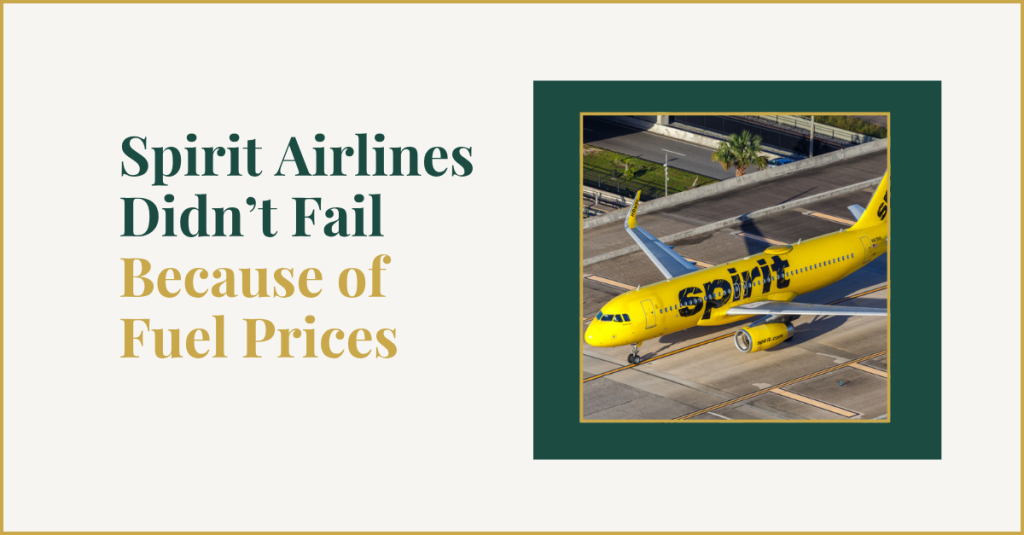
Spirit Airlines shut down on Friday. Seventeen thousand people lost their jobs. Sixty thousand passengers a day left scrambling. Every headline says fuel prices killed them.
They didn’t.
Fuel was the last thing that went wrong. It was not the first.
The Model Was the Problem
Spirit bet on price. Not cost leadership — price. There’s a difference, and the difference is what took them out.
Michael Porter identified four generic competitive strategies: cost leadership, differentiation, cost focus, and differentiation focus. Cost leadership means you produce what you deliver at a lower cost than your competitors — while maintaining quality. That’s the part people skip.
Cost leadership is not about being cheap. It’s about being efficient enough that you can offer a strong product and still have margin left over. The quality stays. The waste goes.
Spirit didn’t do that. Spirit stripped the product down and charged the lowest fare in the market.
No free bags. No free seat selection. No free water. Boarding pass not printed? That’s a fee. By 2024, fifty-nine percent of Spirit’s total revenue came from ancillary fees — bags, seats, drinks, boarding passes. What they built was a pricing strategy disguised as a cost strategy.
The plane still burns the same fuel whether you hand someone a cup of water or charge them four dollars for it. The maintenance schedule doesn’t change. The crew training doesn’t shrink. The cost of production stayed the same. They charged less for it and delivered less with it.
And when you bet on price, you stop paying attention to what the customer wants. CNN ran a headline this weekend: “Too many passengers hated flying it.” That’s not a fuel problem. That’s what happens when the entire model is built around the fare and nothing else.
Customers tolerated Spirit when it was significantly cheaper.
The moment legacy carriers introduced basic economy — similar stripped-down fares with better reliability, better loyalty programs, better connections — Spirit’s one advantage disappeared. Customers left because the product never gave them a reason to stay.

Cost Leadership Includes Quality
This is where the misread happens. Cost leadership does not mean lowest price. It means lowest cost of production while still delivering something the market values. Southwest did this for decades. One aircraft type across the fleet — the 737. Faster turnarounds at the gate. Point-to-point routing.
Those are design decisions that lower operating costs without degrading the experience. Southwest passengers got bags checked for free. They got friendly service. They got reliability. The costs were lower because the operation was designed to be efficient — not because the product was hollowed out.
Spirit’s operating margin ran around ten to thirteen percent in 2018, when the model was still working. By 2024, it had collapsed to negative twenty-two percent. Delta posted a ten percent operating margin in 2025.
The gap between Spirit and the carriers that survived is not about luck or fuel prices. It’s about whether the organization was designed to sustain margin under pressure.
The Iran conflict choked off twenty percent of global oil supply. Fuel costs surged. Spirit faced an estimated three hundred to five hundred million dollars in unbudgeted fuel expenses for 2026 alone.
But Delta faced higher fuel costs too. So did Southwest. So did United. They absorbed it. Spirit couldn’t — not because Spirit had worse luck, but because Spirit had no margin left to absorb anything.

The Bet That Didn’t Hold
Spirit started as a trucking company in 1964. Became a charter airline in 1980. Rebranded in the 1990s. Went ultra-low-cost in the 2000s. Went public in 2011. For a stretch, the model produced growth.
Then the environment shifted. Legacy carriers matched the stripped-down product. Spirit filed for bankruptcy in November 2024. Filed again in August 2025. By Friday, the planes stopped flying.
Each of those moments was a signal. Not one of them was about fuel. The fuel spike was the final variable in a model that needed every variable to cooperate. Fuel didn’t kill Spirit. The absence of margin killed Spirit. The absence of quality killed Spirit. The bet that price alone could sustain a competitive position for thirty-four years — that’s what killed Spirit.

This Isn’t an Airline Story
Any organization that competes on price without building a genuine cost advantage is running the same model Spirit ran. Margin is not a luxury. It’s the thing that lets you survive the quarter when conditions shift. And conditions always shift.
Cost leadership is a strategic discipline. It starts with how the organization operates — which costs are structural, which are variable, which can be reduced through smarter design without sacrificing what the customer values. It does not start with the price tag.
Spirit proved that price and cost are not the same thing. Every organization gets to decide which one it’s building around. Choose carefully. One gives you margin. The other gives you a countdown.
Searcie Cassidine | Founder & CEO, Cassidine Consulting | MBA | Lean Six Sigma Black Belt