

Let me start with a pattern I keep seeing.
A company spends months, sometimes years, building a strategy. The thinking is sound. The resources are there. Leadership is aligned. The launch happens with energy and confidence.
And then something strange begins.
Slowly, sometimes quietly and sometimes with visible chaos, the strategy dissolves.

Let’s unpack this. What exactly is “very nice”? And what’s the alternative — being rude? That’s not screening for manipulation. That’s screening against professionalism.
THE QUESTION THE FIELD HAS NOT FULLY ANSWERED
The field of business strategy produces remarkable thinkers. Michael Porter gave the field a language for competitive positioning and how organizations defend advantage. Other scholars have explored leadership, organizational change, and strategy execution. These contributions are real and important.
Something interesting appears when you look at how strategies behave inside organizations. Most frameworks explain one of three things: how to design strategy, how to execute it, or how to maintain it. What they rarely explain is what happens in the space between those three stages. And that space is where most strategies fail.
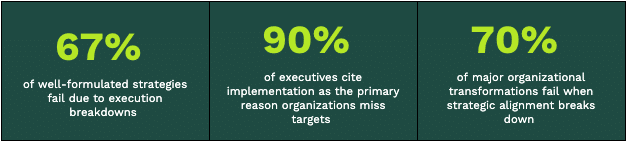
These numbers are not describing a shortage of intelligent leaders or capable employees. They are describing something structural — a gap between what organizations say they intend to produce and what their systems are capable of delivering.
THE WORD EVERYONE USES — BUT NO ONE OWNS
There is a word people reach for when they try to describe this missing step: Operationalize.
Leaders say strategies must be operationalized. Consultants talk about operationalizing initiatives. Research papers refer to operationalizing policy or transformation. The word appears everywhere.
But if you start looking for where this work lives as a coherent discipline, the picture becomes surprisingly fragmented. In academic research, operationalization has a very specific meaning — it refers to translating abstract concepts into measurable variables. In management practice, however, the word is used very differently.
It describes the process of translating strategic intent into a functioning organizational system — one that includes leadership behavior, incentives, processes, decision authority, technology, and capacity. These elements interact continuously. Organizations behave less like machines and more like ecosystems.
When that ecosystem aligns with strategy, the strategy becomes real. When it does not, the strategy dissolves.

This is the same diagnostic-first principle we apply in organizational design: you cannot fix what you haven’t correctly identified. A tool that mislabels what it measures will consistently produce the wrong output — no matter how many candidates it screens.
For the record: I do use personality assessments in my consulting work. They offer useful insight. I typically use the Enneagram alongside one to fifteen other assessments, and I treat them as what they are — a starting point for self-awareness, not a replacement for strategic thinking. The problem isn’t the test. It’s treating the test as a decision-maker.
THE CASSIDINE THEORY REALITY GAP

When the organizational ecosystem required to deliver a strategy does not exist, structural misalignment appears. I describe this as the Cassidine Theory Reality Gap — the distance between what a company articulates as its strategic intent and what it has built (its people, systems, incentives, and culture) to deliver.
That gap is rarely visible from the top of the organization. Instead, it shows up in patterns:
The initiative launched with energy and stalled three months later. The training program received great feedback scores but produced no behavioral change. The strategy that produced the same results for the third year in a row despite a new plan.

WHEN THE GAP BECOMES A CYCLE
What makes the Cassidine Theory Reality Gap particularly persistent is that it rarely remains static. Organizations respond to the gap. They launch new initiatives. They reorganize teams. They introduce new leadership programs.
But if the underlying organizational ecosystem remains unchanged, those responses do not close the gap. They reinforce it. Over time, the organization enters a recurring loop: new strategy, new execution effort, and structural misalignment.
I describe this pattern as the Cassidine Theory Reality Cycle. Each cycle attempts to solve the results without addressing the system producing them.

WHEN THE GAP BECOMES A CYCLE
My name is Searcie (sir-see) Cassidine. My work sits at the intersection of strategy and operations — the place where strategic plans meet the realities of organizational systems.

This cross-disciplinary lens matters because the problem I am describing does not belong to a single field. Pieces of it exist in strategy research, organizational behavior, operations management, and change leadership. But the full problem lives between them.
Operations work has a way of forcing honesty about how organizations actually behave. When you work at the process level, abstract models eventually collide with reality. The system corrects you. Repeatedly. That experience shaped the way I began thinking about strategy failure.
THE RESEARCH JOURNEY AHEAD
The next step for me is a doctorate. I want to examine these ideas formally — taking what I have developed in practice and subjecting it to the kind of rigorous examination that allows the field to build on it.
The questions driving this work sit across several disciplines: strategy, operations, organizational design, and human systems. I am still in that process, synthesizing my writing, exploring programs, and preparing for the research journey ahead.
And I decided I was not going to wait until that journey was complete to start sharing the work publicly.
The next step for me is a doctorate. I want to examine these ideas formally — taking what I have developed in practice and subjecting it to the kind of rigorous examination that allows the field to build on it.
The questions driving this work sit across several disciplines: strategy, operations, organizational design, and human systems. I am still in that process, synthesizing my writing, exploring programs, and preparing for the research journey ahead.
And I decided I was not going to wait until that journey was complete to start sharing the work publicly.
This is where I will share that journey. But it is not only about the journey — it is also a teaching platform.
Alongside the research, I will teach the frameworks and tools that help leaders understand how organizations function. How strategy becomes a sustainable reality. How organizational ecosystems form and sustain behavior. What it takes to design systems that produce the results leaders intend.

If you have ever watched a well-built strategy fall apart and wondered why — not at the execution level, but at the design level — then you are in the right place. Let us figure this out together.
Sound familiar? Let’s talk.
If you have ever watched a well-built strategy fall apart and wondered why — not at the execution level, but at the design level — then you are in the right place. Let us figure this out together. Schedule Conversation
What Happens After Execution?
What happens after the strategy is built, the plan is…
Read More scassidine

Personality Tests Don’t Work for Hiring — Do This Instead | Cassidine Consulting
Personality tests fail at screening because they can’t distinguish professionalism…
Read Morescassidine